
Even when an AI system answers a question directly, your website can matter as a verifiable source, a useful explanation or a provider of a suitable product. You do not need secret AI markup. You need accessible pages, clear claims and information that answers real questions.
Does GEO replace search engine optimisation?
GEO usually means Generative Engine Optimization: making information discoverable and understandable to generative search and answer systems. You may also encounter LLMO. These labels do not have one universally accepted definition or imply a guaranteed technique.
Google explains that established SEO fundamentals remain relevant to AI Overviews and AI Mode. Its official documentation does not require an additional special optimisation method. Inclusion or a source link is not guaranteed, however.
My approach is to retain SEO as the technical and editorial foundation. Then ask whether each important section remains accurate when read without the rest of the article. That helps readers as well as automated systems.
1. Check whether systems can reach the content
A strong article is of little use to a crawler encountering an error, a login screen or an empty JavaScript shell. Review important URLs, canonical links, internal navigation and accidental indexing restrictions. A useful page should be reachable through understandable links.
OpenAI distinguishes search access from model-training crawling. OAI-SearchBot and GPTBot therefore should not be treated as interchangeable. Perplexity also distinguishes its search crawler from user-triggered fetching. Consult the current official documentation before changing access rules.
A firewall may block legitimate requests even when robots.txt allows them. Inspect logs and verify crawlers using the providers’ published information. Do not expose private areas or disable security controls indiscriminately to improve discoverability.
2. Answer a specific question in each section
Start with a concise, supported answer, then explain conditions, examples and limitations. Use descriptive H2 and H3 headings. A comparison table is useful when it explains meaningful differences rather than repeating keywords.
Consider this fictional wording example. Instead of “Our solution is efficient and innovative”, write: “The booking form supports individual appointments up to 60 minutes. It currently does not support group sessions or recurring bookings.” Its explicit limitations make it informative. This is not a claim about an actual product.
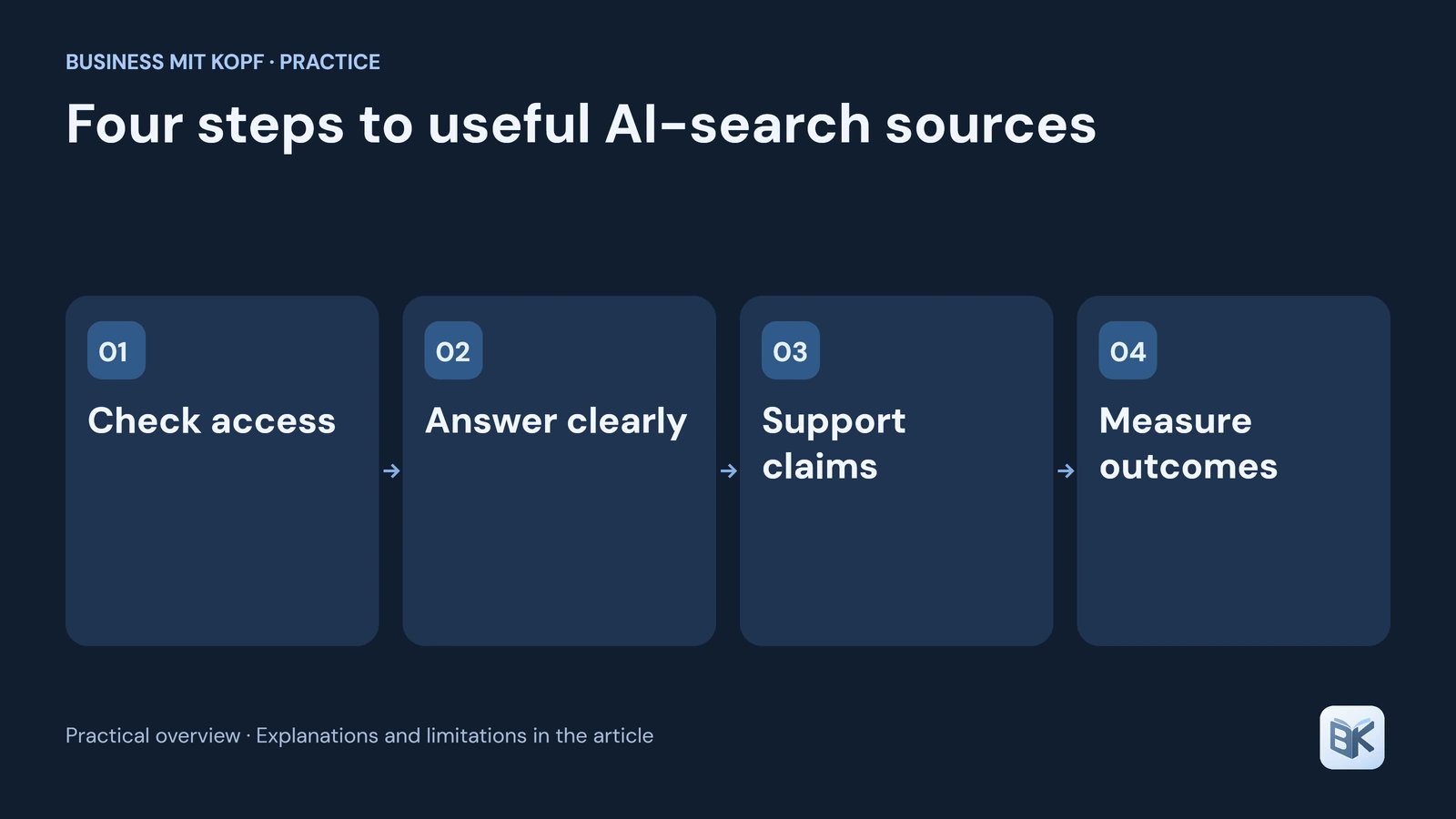
3. Make the basis of your claims visible
For technical and legal statements, link to original documentation where possible. Identify the author, relevant scope and reference date for changeable information. Explain genuine first-hand observations: what was tested, under which conditions and what happened?
Distinguish measurements from opinions. “The upload took twelve seconds in our test” requires an actual documented test. Without that evidence, explain a method or use an explicitly fictional example instead.
A source list does not automatically make a paragraph reliable. Check whether the source supports the precise claim. Unsupported superlatives and apparently precise numbers do not make information more suitable for citation.
4. Align visible information and structured data
Machine-readable information must match what visitors can see. Use appropriate established types for articles, organisations or products where they fit the page. Do not insert ratings, prices or author details that readers cannot substantiate.
An additional AI-oriented information file may be an experiment, but it is not a universal requirement or guaranteed ranking lever. Prioritise the accessible page and accurate information. Automatically generating a hundred FAQs does not replace useful answers.
Check contradictions between pages too. If a service is available only in Germany, another summary should not present it as a global offer. Accuracy matters more than repeating the same term as frequently as possible.
5. Measure useful outcomes, not isolated mentions
Choose ten questions that prospective customers actually ask. Regularly inspect cited sources and whether systems reproduce your information accurately. Record the date, system and question. Answers vary; one mention does not establish a stable ranking.
Also monitor qualified visits, enquiries and purchases. Not every AI-mediated visit carries an identifiable referrer. Unknown sources do not let you calculate a precise number of otherwise invisible AI visitors. A smaller trustworthy measurement is more useful than an unsupported estimate.
A manageable four-week plan
- Week 1: Check five important pages for accessibility and clear audience questions.
- Week 2: Add direct answers, concrete examples and useful limitations.
- Week 3: Review sources, author information, internal links and structured data.
- Week 4: Repeat the same question tests and evaluate actual enquiries or purchases.
Keep the initial scope small enough to complete. Improve a page with a genuine audience need before expanding the project across an entire archive. That makes it easier to assess what changed and whether customers benefit.
Conclusion: GEO offers a useful perspective on clear, verifiable information. It does not replace SEO or a valuable product. Make your content understandable and checkable for people first, and you also create a stronger foundation for AI-assisted search.
Sources and image credits
Image credits
Cover motif: AI-generated conceptual image using OpenAI / ChatGPT. Typography and supplementary infographic: Business mit Kopf. Not a documentary photograph.
0 comments
No comments have been published yet.