
“A gift for someone who enjoys cooking, has little space and already owns everything.” That request rarely fits into one keyword. AI-assisted search can turn it into a conversation. For online retailers, explaining suitable uses, limitations and reliable delivery information therefore matters as much as naming a product.
From a keyword to a conversation
A conventional search might begin with “cooking gift under €50”. A conversation adds constraints: dishwasher-safe, no electronics, delivery in Germany and minimal packaging. An AI system can narrow suggestions and explain trade-offs.
Convenience does not guarantee a complete market overview. Products may be missing, details outdated or recommendations based on incomplete information. Buyers should verify the exact variant, price, availability and return terms with the retailer.
OpenAI’s documentation distinguishes organic product results from separately labelled advertisements. A product suggestion is not automatically a paid placement. Buying an advertisement does not guarantee a recommendation in an organic answer either.
What a helpful gift product page explains
“The perfect gift for everyone” offers little guidance. Explain who the item suits and where it is useful. For a compact coffee grinder, relevant details might include dimensions, weight, manual operation, grind adjustment and suitable situations.
Include limitations: it is not electric, only handles small quantities or cannot go in a dishwasher. These details may feel less promotional, but they can prevent unsuitable purchases. Both people and search systems gain a clearer understanding.
| Gift-shopping question | Useful product information |
|---|---|
| Does it suit the recipient? | Interests, experience level and intended use |
| Will it fit their home? | Actual dimensions and a visual size reference |
| Is everything included? | Contents and any necessary accessories |
| Will it arrive in time? | Current stock and realistic delivery estimates |
| What if it is unsuitable? | Clear return and exchange information |
Build a gift guide that works without AI
Create a concise page with three to five carefully selected ideas. Organise them by budget and interests, for example. Link each recommendation to the exact product variant and explain who it suits and who should choose something else.
For instance: “For coffee enthusiasts with a small kitchen: a compact hand grinder. Useful for single cups and travel; less suitable for preparing several large pots quickly every morning.” This is more informative than a list of interchangeable superlatives.
Answer actual customer questions in visible text. Do not place important specifications exclusively inside an image or PDF. Use clear headings and stable product URLs. When a product has variants, the displayed price, image and availability must match the selected version.
Keep product data and the store aligned
Structured product data and merchant feeds can make attributes machine-readable. They do not replace an understandable product page. Conflicting stock levels or prices undermine trust and can lead to disappointing purchases.
Check each platform’s official requirements, including Google Merchant Center and OpenAI’s merchant information where relevant. Eligibility, market availability and data submission routes can change. Providing a feed does not create an entitlement to inclusion or preferential placement.
During the Christmas period, briefly check your most important gift products every day: available variants, delivery information, prices and working checkout buttons. Prioritise a small range you can reliably fulfil instead of publishing an extensive guide full of outdated offers.
Make delivery promises carefully
Calculate order deadlines from your own stock, processing time, shipping service and actual carrier commitments. A date copied from another retailer is not evidence that your business can meet it. Allow for weekends and foreseeable capacity limits.
When arrival before Christmas becomes unrealistic, update the message prominently. Digital gift cards or local collection may provide alternatives if you genuinely offer them. Describe gift cards clearly: they are not a physical item that the recipient can use immediately.
This article uses the German Christmas retail context for its examples. Consumer rights, shipping arrangements and marketing requirements differ across countries; international stores need market-specific information.
Measure useful outcomes
Keep a consistent set of realistic gift questions and record the date and system used for each test. Check whether your product information is reproduced accurately. Individual answers are snapshots, not a reliable ranking report.
In your store, qualified visits, completed orders, basket value and returns matter more than mentions alone. AI referrals are not always fully identifiable. Missing referrers do not let you calculate a precise number of otherwise invisible AI visitors.
A practical next step
Choose five gift products. Add their suitability, limitations, dimensions, contents and current delivery information. Turn them into a useful gift guide and keep those details current until Christmas. The strongest preparation for AI-assisted gift discovery is an offer that people can understand without AI.
Sources and image credits
Image credits
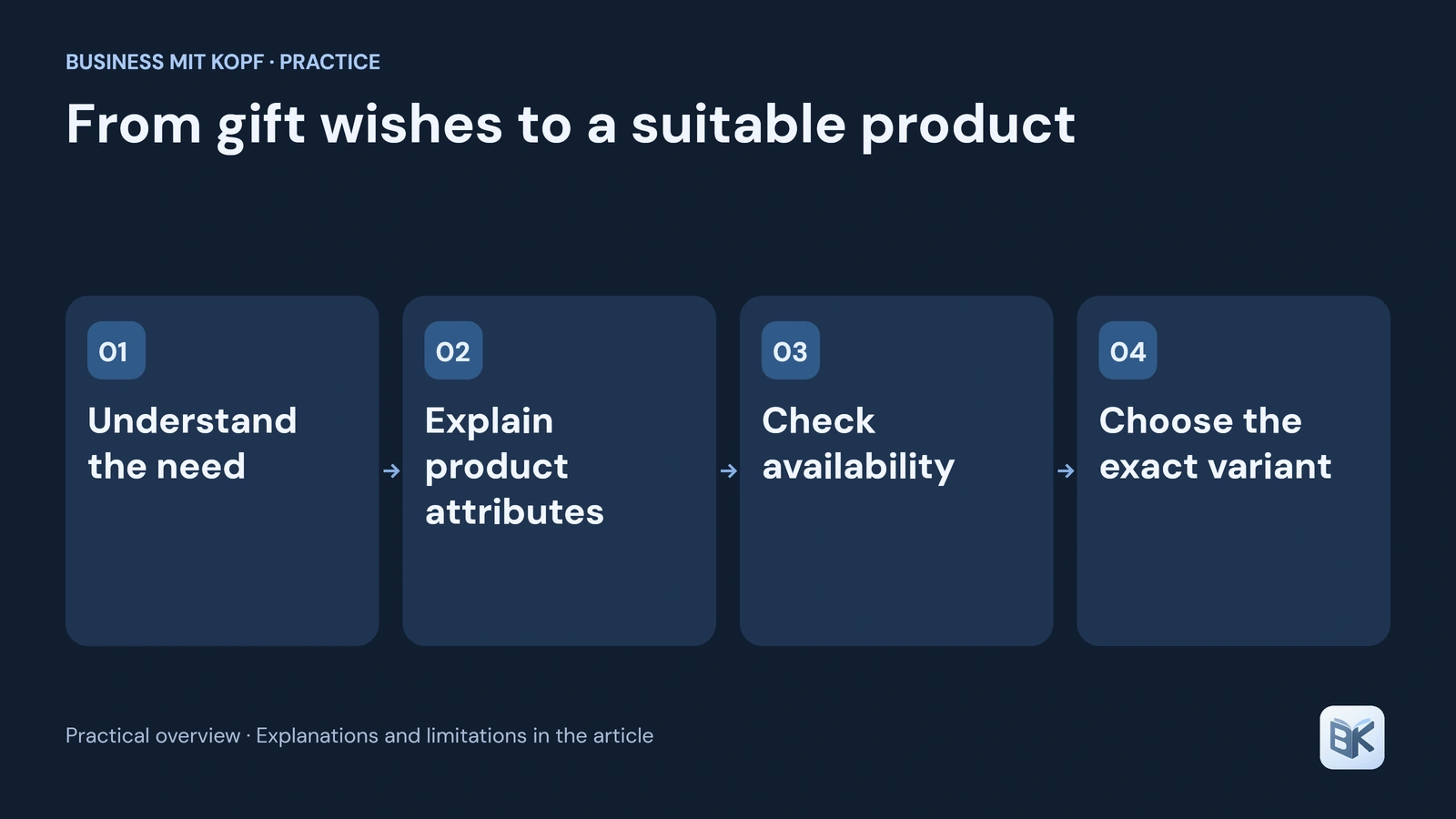
Cover motif: AI-generated conceptual image using OpenAI / ChatGPT. Typography and supplementary infographic: Business mit Kopf. Not a documentary photograph.
0 comments
No comments have been published yet.